The night sky looks different depending on where you're standing—and the world's best places to experience it span every continent, every hemisphere, and almost every traveler type. A Gold-certified Dark Sky Park in the Scottish Highlands. Africa's only officially recognized Dark Sky Reserve, deep in the Namibian wilderness. The high-altitude Atacama Desert in Chile, where professional astronomers have pointed their most powerful instruments for decades.
Astrotourism is one of the fastest-growing travel trends on the planet—if you're new to it, start here. The short version: It's travel planned around experiencing the night sky, and 62% of travelers say they plan to do it. The harder question is: Where?
The short answer:
- Atacama Desert, Chile - The world's premier stargazing destination, home to more major observatories than anywhere on Earth
- Aoraki Mackenzie Reserve, New Zealand - Gold-tier certified, with a Southern Hemisphere sky unlike anything visible from northern latitudes
- NamibRand Nature Reserve, Namibia - Africa's only certified Dark Sky Reserve; pairs Big Five safari with a Milky Way that casts actual shadows
- La Palma, Canary Islands - The most accessible dark sky destination in Europe, with UNESCO-backed Starlight Reserve status
- Iceland - The world's most-searched aurora destination, now in peak solar maximum conditions through 2026
- Galloway Forest, Scotland - The UK's first Gold-level certified Dark Sky Park, and one of Western Europe's best-kept dark sky secrets
Read on for what makes each worth the journey.
What Earns a Destination a Spot on This List
Not every dark place is a destination. Plenty of locations with minimal light pollution offer little else—no lodges equipped for extended stays, no local expertise, no infrastructure to turn a clear sky into a meaningful experience.
What earns a place on this list is a combination of three things: certified or widely recognized darkness, a travel experience that extends beyond the sky itself, and genuine infrastructure for visitors who want more than a parking lot and a tripod.
DarkSky International has certified more than 200 Dark Sky Places across 22 countries, and that certification is the primary credential referenced here. Where a destination isn't formally certified—the Atacama Desert being the notable exception—it earns its place by virtue of the observatories and astronomical institutions that have voted with their equipment.
The best astrotourism destinations also tend to stack experiences. When the sky clouds over—and it will, eventually—you want to be somewhere worth being, anyway.
The Six Best Astrotourism Destinations in the World
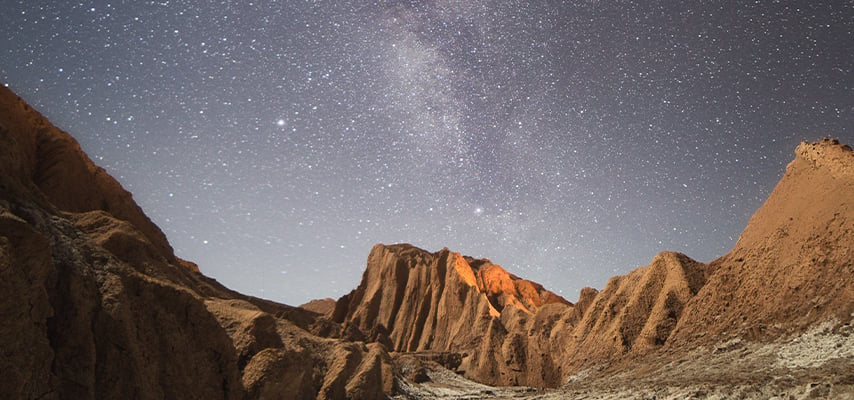
1. Atacama Desert, Chile
No other place on Earth has concentrated as much serious astronomical infrastructure as Chile's Atacama Desert. The European Southern Observatory's Paranal site, ALMA (the world's largest radio telescope array), and several public-facing observatories have all chosen this location for the same reason: virtually no humidity, minimal cloud cover, high altitude, and near-zero light pollution across a vast, sparsely populated plateau. The result is a sky that professional astronomers describe in terms usually reserved for something more spiritual.
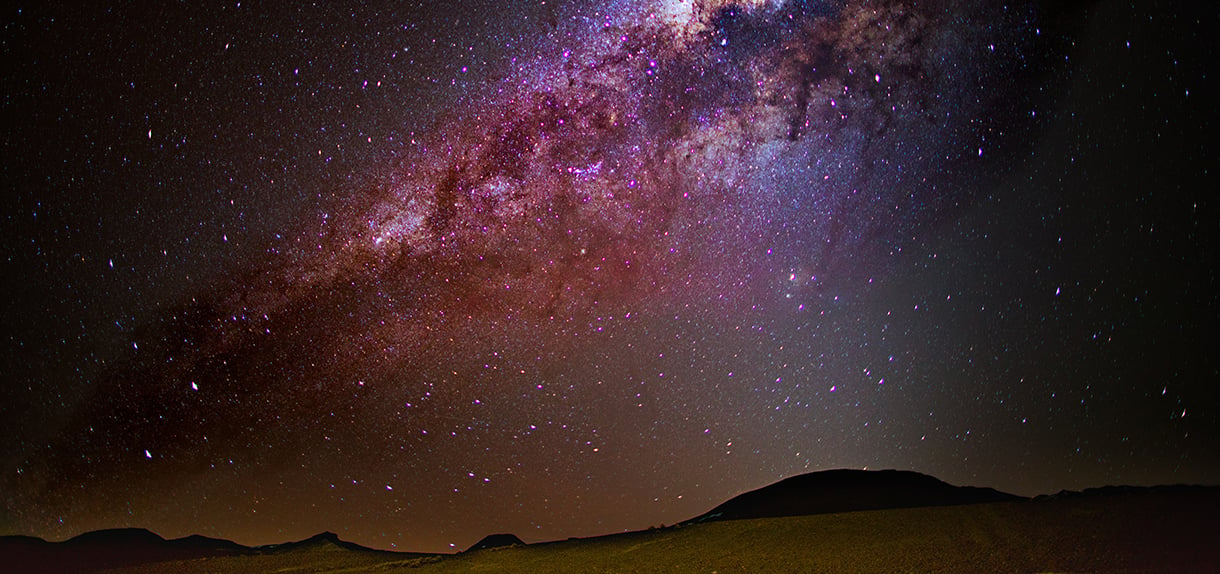
For travelers, the Atacama offers something rarer than a dark sky—it offers a dark sky with expert interpretation. Lodges such as Alto Atacama and Explora Atacama partner with local astronomical guides, who lead telescope sessions under skies so clear that the Milky Way's structure is visible to the naked eye. The Magellanic Clouds—two satellite galaxies of our own Milky Way—hang on the southern horizon like luminous smudges. The galactic core rises directly overhead in the Southern Hemisphere winter, which is the optimal window for a visit.
Beyond the night sky, the Atacama is one of the most surreal landscapes on Earth: salt flats, flamingo-filled lagoons, volcanic geysers at dawn, and the silence of a place where it almost never rains. A good sky night here feels like a bonus on top of an already extraordinary trip.
Best time to go: June-August (Southern Hemisphere winter; driest months, Milky Way core high in the sky)
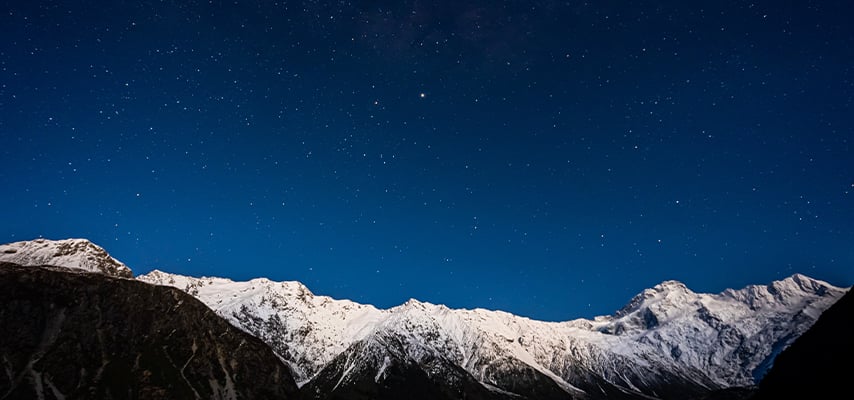
2. Aoraki Mackenzie International Dark Sky Reserve, New Zealand
New Zealand is home to some of the world’s best-known Dark Sky Reserves, including the Aoraki Mackenzie International Dark Sky Reserve—a Gold-tier certified reserve centered on Aoraki/Mount Cook National Park on the South Island.
What makes this destination genuinely singular is the sky itself. The Southern Hemisphere sees a fundamentally different night sky than the Northern. The Southern Cross—absent from mid‑ and high‑northern latitudes—anchors the southern sky. The Large and Small Magellanic Clouds are visible as distinct structures. And the galactic core of the Milky Way rises high overhead rather than hugging the horizon, producing the kind of image that makes astrophotographers plan entire trips around a single night.
Dark Sky Project (formerly Earth & Sky) runs guided stargazing tours from the Mt. John Observatory above Lake Tekapo—one of the most photographed stargazing locations in the Southern Hemisphere.
The lake's reflective surface, the snow-capped presence of Aoraki in the background, and the sweep of the southern Milky Way overhead produce a scene that photographs barely do justice. Multi-night stays in the Mackenzie Basin allow time for both the sky and the high-country landscape surrounding it.
Best time to go: June-August (Southern Hemisphere winter; longest nights, consistently clear, cold skies)
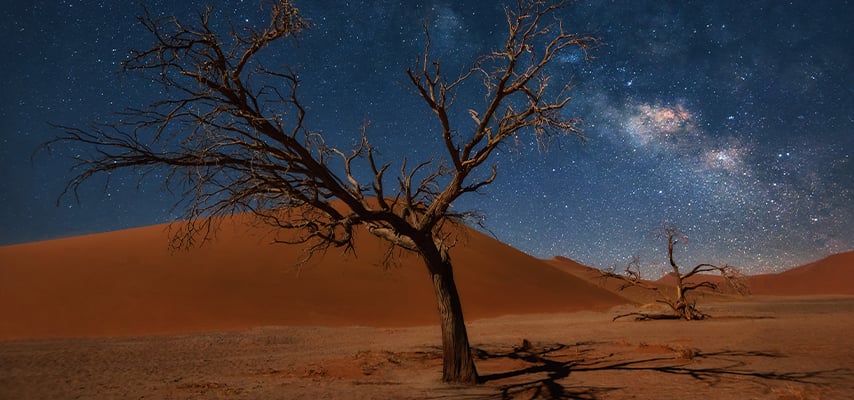
3. NamibRand Nature Reserve, Namibia
Africa's only certified Dark Sky Reserve sits inside NamibRand—a vast, privately managed conservation area bordering the Namib-Naukluft National Park in southern Namibia. The reserve's certification was no accident: NamibRand is one of the most remote inhabited areas on the continent, and the absence of any significant human settlement for hundreds of kilometers in every direction produces a sky of extraordinary depth.
The Milky Way casts actual shadows on clear nights here. That's not a metaphor—the combined light of the galactic core is bright enough to read by in optimal conditions, a claim only a handful of places on Earth can make. The Sossusvlei Desert Lodge has a private observatory with a professional-grade telescope, dedicated astronomer on staff, and skylight above every bed so the night sky is the last thing you see before sleep.
What elevates Namibia above a purely astronomical destination is the layering of experiences. This is the destination for travelers who want the Milky Way above a 300-meter dune at midnight and a Big Five game drive at dawn. The safari-by-day, stars-by-night combination is one of the most compelling itinerary frames in all of experiential travel, and Namibia executes it as well as anywhere on Earth.
Best time to go: April-October (Southern Hemisphere autumn/winter; dry season, clearest skies)
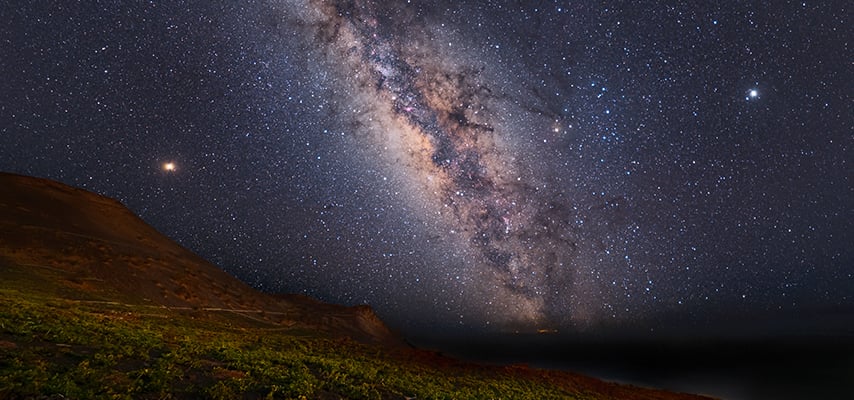
4. La Palma & the Canary Islands, Spain
La Palma is the kind of destination that surprises people who assume European stargazing means settling for something less dramatic. It doesn't. The island holds a Starlight Reserve designation—a UNESCO-backed certification for exceptional night sky quality—and is home to the Roque de los Muchachos Observatory, one of the most important astronomical research facilities in the Northern Hemisphere. The observatory sits at 2,396 meters, above the cloud layer that frequently blankets the lower slopes. The Gran Telescopio Canarias up there is the world's largest single-aperture optical telescope.
What La Palma offers that few destinations in this list can match is accessibility. Direct flights connect the island to mainland Spain and several major European hubs; U.S. travelers routing through Madrid can be there in under 24 hours from most East Coast cities. The island's terrain—dramatic volcanic peaks, ancient laurel forests, a coastline that drops steeply into the Atlantic—makes even a cloudy night worth the visit.
The Canary Islands sit far enough south that the night sky includes southern constellations not typically visible from continental Europe, including a clear view of Canopus and the tail of Centaurus. Guided tours from the observatory visitor center at Roque de los Muchachos are bookable in advance and offer access to some of the most rarefied stargazing in the world—at a price point that would surprise you.
Best time to go: April-October (fewest clouds, most stable atmospheric conditions; winter also viable)
5. Iceland
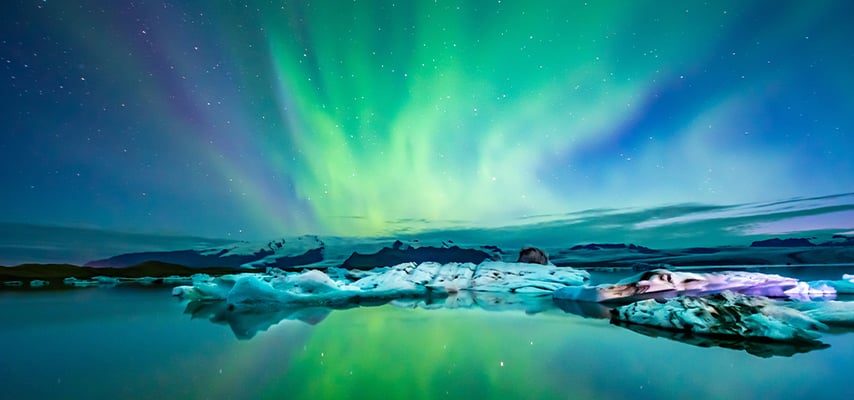
Iceland occupies a unique position in this list: It's simultaneously the most-searched astrotourism destination in the world and one of the most weather-dependent. The combination of Northern Lights activity, long winter nights, and stark volcanic landscapes has made Iceland the shorthand for aurora travel—and that reputation is largely earned.
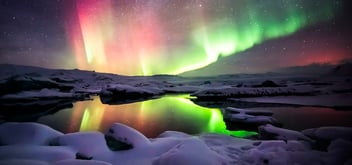
The current solar maximum cycle through 2026 makes Iceland's window particularly compelling. Geomagnetic activity has been running at elevated levels for two consecutive years, pushing aurora displays to higher intensities and lower latitudes than usual. More nights are producing visible aurora activity, and the lights themselves—curtains of green, deep violet, and occasional red—are appearing with a frequency and intensity that visitors from quieter solar cycles rarely witnessed.
What makes Iceland logistically distinct from the other destinations in this piece is the importance of flexibility. No reputable Iceland aurora guide will promise a sighting on any given night; weather and geomagnetic activity are the twin variables, and neither is controllable. The travelers who return from Iceland transformed are the ones who built in four to seven nights, identified multiple dark locations across the country, and treated the uncertainty as part of the experience rather than a source of anxiety.
Beyond the aurora, Iceland offers glacier hikes, volcanic hot springs, lava fields, and some of the most dramatic driving routes on Earth. A dark sky trip here almost always becomes something larger.
Best time to go: September-March (long nights, peak aurora season; solar maximum extends favorable conditions through 2026)
6. Galloway Forest Dark Sky Park, Scotland
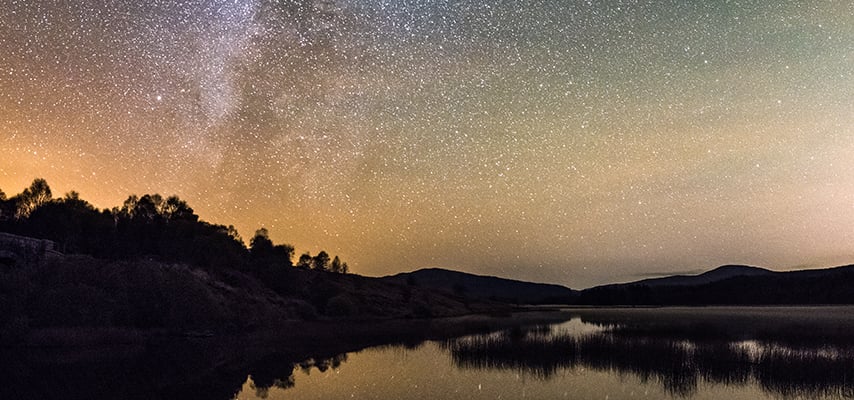
Galloway Forest is Europe's dark sky secret: the first Gold-level certified Dark Sky Park in the United Kingdom, and one of the clearest, most accessible dark sky sites in all of Western Europe.
The park covers approximately 300 square miles of ancient woodland, moorland, and river valleys in southwest Scotland. Its distance from major cities and the low density of surrounding settlement have preserved a night sky that most visitors from the U.K. or continental Europe have never experienced from their home country. Dark Sky Ranger events run throughout autumn and winter, led by trained guides at five designated observation points within the park.
The appeal for North American travelers is the combination of scale and cultural depth.
The Dumfries & Galloway region surrounding the park is full of medieval abbeys, whisky distilleries, coastal villages, and walking routes that make a dark sky visit feel embedded in a broader Scottish experience rather than a single-purpose pilgrimage. It's the easiest entry point in this list for first-time international astrotourists—and one that consistently surprises experienced travelers who arrive expecting a consolation prize.
Best time to go: October-March (longest nights, Gold designation conditions; clear winter nights are exceptional)
Honorable Mentions
Six destinations can't hold the whole sky. A few others worth knowing:
AlUla, Saudi Arabia - Newly certified by DarkSky International and arguably the most dramatic emerging astrotourism setting in the world: pristine desert skies above ancient Nabataean ruins that predate the Roman Empire by centuries. Saudi Arabia's recent opening to international tourism makes AlUla more accessible than it's ever been, but logistics and visa requirements still place it in the expedition category. One to watch—and to start planning before the rest of the world catches up.
Wadi Rum, Jordan - The desert valley made famous by Lawrence of Arabia and The Martian is not formally DarkSky certified, but its combination of extraordinary darkness and Bedouin camp glamping makes it one of the most memorable stargazing settings in the world. No advance visa required for U.S. travelers.
Mayo Dark Sky Park, Ireland - Europe's only other Gold-tier certified Dark Sky Park outside of Galloway, set on Ireland's dramatic northwest coast. A natural addition to any Ireland itinerary.
Bükk National Park, Hungary - Three certified Dark Sky Parks in a single central European country, with easy access from Budapest. An underrated option for travelers already planning a European circuit.
The Night Sky Rewards the Well-Planned Trip
The destinations in this guide share one quality beyond certified darkness: They all reward travelers who did the work. The Atacama in the wrong season is a dramatic landscape with a mediocre sky. Iceland on a single night is a gamble. Namibia without a lodge inside the reserve is a missed opportunity. Galloway Forest on a full moon is just a walk in the woods.
The variables that make astrotourism exceptional—lunar cycles, seasonal windows, weather contingencies, accommodation within the dark zone—are not complicated once you understand them. But translating that knowledge into a specific itinerary for a specific traveler is exactly the work an InteleTravel Advisor is positioned to do.
An advisor can time your Chile trip around the June new moon, book a room at a DarkSky-certified lodge inside NamibRand, and build the multi-night flexibility into your Iceland itinerary that separates a sighting from a story you'll tell for years. They work with preferred partners who specialize in the kind of custom, experience-first travel that astrotourism demands.
The stars have always been there. The right trip is the one where you can actually see them.
Connect with an InteleTravel Advisor to start planning your astrotourism journey.